Dr Sajjal Almas ST6 AIM OOP Stroke; Take AIM Fellow
Stroke medicine has evolved dramatically over the last decade. What was once seen primarily as a rehabilitation-focused specialty is now one of the most acute, fast-paced and intervention-driven areas of medicine. From thrombolysis and thrombectomy to hyperacute stroke care and neurocritical decision-making, stroke medicine sits firmly at the interface of acute and specialist care.
For trainees in Acute Internal Medicine, this makes stroke medicine an increasingly attractive Out of Programme (OOP) opportunity.
*Why Stroke Medicine Fits So Well with AIM*
Acute Internal Medicine (AIM) is built around rapid assessment, early decision-making, managing physiological instability and coordinating multidisciplinary care. Stroke medicine requires exactly the same skillset.
Hyperacute stroke pathways demand clinicians who can:
* Make rapid diagnostic decisions
* Differentiate stroke mimics from true cerebrovascular events
* Manage acute hypertension, arrhythmias and medical complications
* Lead complex multidisciplinary discussions
* Coordinate urgent imaging and reperfusion therapies
These are all strengths developed during AIM training.
Modern stroke physicians are heavily involved in front-door medicine, ambulatory pathways, critical care discussions and acute medical takes. Many stroke consultants continue contributing to general internal medicine and acute unselected takes, making the specialty particularly compatible with AIM careers.
*What Does Stroke OOP Training Involve?*
Traditionally, stroke medicine has been undertaken as a sub-specialty year attached to parent specialties such as:
* Acute Internal Medicine
* Geriatric Medicine
* Neurology
* Rehabilitation Medicine
* Cardiology
* Clinical Pharmacology and Therapeutics
The training focuses on the entire stroke pathway:
* Hyperacute stroke assessment
* Thrombolysis and thrombectomy pathways
* Acute stroke unit management
* Secondary prevention
* Neurorehabilitation
* Community and rehabilitation services
* Stroke clinics and TIA services
* Leadership, audit and service development
JRCPTB-aligned programmes also expect trainees to gain competencies in research, quality improvement and national stroke audit involvement.
For AIM trainees, an OOP year in stroke medicine can significantly enhance confidence in:
* Acute neurology
* Blood pressure emergencies
* Frailty and rehabilitation planning
* Difficult communication and prognostication
* Complex inpatient medicine
*The Application Process*
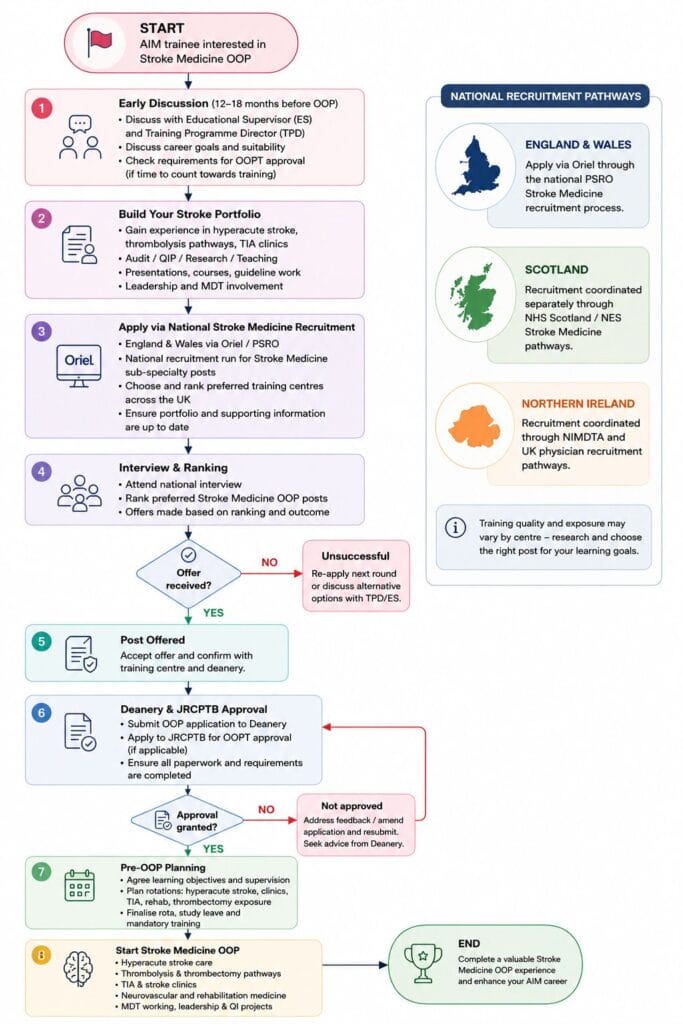
For Acute Internal Medicine trainees, applying for a Stroke Medicine OOP post usually involves early discussion with your Educational Supervisor and Training Programme Director to ensure the placement aligns with your career goals and curriculum requirements. Trainees are generally encouraged to identify a recognised stroke training centre offering exposure to hyperacute stroke care, thrombolysis, thrombectomy pathways, stroke rehabilitation and outpatient services. Applications typically require approval from the deanery and JRCPTB in advance, particularly if trainees wish for the time to count towards training competencies (OOPT). Many posts are advertised locally through deaneries or tertiary neuroscience centres, although some trainees arrange bespoke experiences depending on regional opportunities. Having evidence of interest in stroke medicine — such as audit, quality improvement projects, research or teaching — can strengthen applications, particularly as stroke increasingly overlaps with front-door acute medicine and hyperacute care pathways.
One of the biggest recent developments has been the introduction of single-accreditation General Internal Medicine with Stroke Medicine programmes.
According to the Physician Higher Specialty Training Recruitment Office, trainees can now complete two years of General Internal Medicine and one year of Stroke Medicine after Internal Medicine Training Stage 1, leading to CCT in a streamlined three year pathway.
*Why AIM Trainees Should Seriously Consider Stroke*
There are few specialties where you can:
* Deliver genuinely time-critical interventions
* See immediate treatment outcomes
* Combine acute care with rehabilitation medicine
* Work closely with radiology, thrombectomy and critical care teams
* Lead large-scale service improvement projects
* Continue practising broad internal medicine
Stroke medicine also offers strong opportunities in:
* Research
* Digital health and telemedicine
* Ultrasound and neuroimaging
* Medical leadership
* National quality improvement programmes
As the NHS continues expanding thrombectomy networks and hyperacute stroke services, demand for clinicians with expertise in stroke medicine continues to rise.
*Final Thoughts*
For AIM trainees looking for an OOP experience that combines procedural urgency, diagnostic challenge, multidisciplinary working and genuine long-term patient impact, stroke medicine offers an incredibly rewarding option.
The overlap between AIM and stroke medicine has never been greater. Acute physicians already possess many of the core skills needed to thrive in hyperacute stroke care — and a dedicated stroke OOP can add another exciting dimension to a future AIM consultant career.
Whether your interests lie in hyperacute medicine, ambulatory care, neurovascular disease or service leadership, stroke medicine is becoming an increasingly valuable and relevant pathway for the modern acute physician.